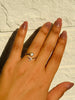
Silver Om Ring Meaning, Plus Swastik, Trishul and Ek Onkar
Share
Search silver Om ring meaning and you get one of two pages: a devotional essay with nothing to buy, or a product listing with two lines of description. Nobody looks it up for the shape. They look it up for what it carries.
A reference for the five symbols that turn up most in 925 silver in India: Om, Swastik, Ek Onkar, Trishul and Tulsi - what each means, who wears it, which piece survives daily life. Beliefs are written here as beliefs; we sell jewellery and are not issuing religious rulings.
Why symbol jewellery is worn on the body and not kept on a shelf
An idol sits in a mandir and gets attention at fixed times. A symbol on a chain goes to work, into a metro, into an exam hall - and meets skin, sweat, wool and dupattas all day. An open cut-out snags; a deep engraving does not.
Om (ॐ) - the sound, the three curves, and what the dot means
Om, written ॐ and transliterated Aum, is a sound before a shape. The Mandukya Upanishad reads it as A-U-M, the three parts mapping onto waking, dreaming and deep dreamless sleep. The dot is a fourth state, turiya; the crescent below is read as maya.
Proportion matters: below about 10 mm the dot and crescent close up first, and what is left reads as a squiggle.
Who wears Om, and on which piece
Om is the least gendered of the five and the most widely worn.
- Divine OM Ring for Women ₹3,399 in sizes 8-20, and the heavier Sacred Om Ring ₹4,299 in sizes 16-30.
- Divine OM Band for Men and Divine OM Band for Women, both ₹2,399 on black thread - the version that takes daily wear best.
- Sacred Om Neckpiece from ₹3,799, Divine Om Studs ₹3,399, Om Rudraksha Bracelet ₹3,599.
Swastik - the four arms, and separating it from the Nazi hakenkreuz
The word is Sanskrit: su, good, plus asti, to be - roughly, well-being. The right-facing form is drawn at thresholds and on the first page of a new account book at Diwali. Readings of the four arms vary and none is official.
The symbol is far older than the twentieth century; the Nazi Party adopted a tilted black version, the hakenkreuz, in 1920. German law is narrower than usually reported - it bans the mark as the insignia of a banned organisation, and religious use in the Hindu, Buddhist and Jain sense is not what it aims at. Worn openly in Europe it will still be misread.
Swastik pendant vs Swastik band: which one gets worn daily
Four arms means four outer corners, more catch-points than an Om. An open cut-out Swastik finds every loose thread in a woollen kurta; a closed frame or band does not.
- Framed pendants: Shubh Swastik Pendant ₹4,999, Divine Swastik Pendant ₹3,999, Divya Swastik Neckpiece from ₹3,499.
- Bands: Swastik Band for Men and Swastik Band for Women, both ₹2,599. Studs: Divine Swastik Studs for Men from ₹2,299.
Ek Onkar (ੴ) - one creator, and a note on wearing it respectfully
Ek Onkar (ੴ, also written Ik Onkar) opens the Mool Mantar and is the first line of the Guru Granth Sahib: "there is one" - one creative reality, present in everything.
Because it is scripture rather than a motif, etiquette runs stricter in most Sikh households: kept above the waist, off anything likely to reach a floor or bathroom shelf. A band clears that - Ek Onkar Band for Men and Ek Onkar Band for Women, both ₹2,099.
Trishul and damru - Shiva's mark, and why it suits men's studs and lockets
Trishul means three spears; the prongs are read as creation, preservation and destruction, or as the gunas sattva, rajas and tamas. The damru, the two-headed drum at the shaft, has its own story - Shiva's beat of it is described as the first sound. It is the most linear of the five, so it survives being small, and is usually oxidised: darkened recesses make a thin trident readable at 10 mm.
- Divine Trishul Studs for Men from ₹1,799 a single stud; Divine Trishul Studs for Women ₹3,199; Trishul Damru Single Stud from ₹2,299.
- Oxo Trishul Locket ₹5,499 and Rudra Trishul Bracelet ₹3,599.
Tulsi - the one symbol here that is a plant, not a shape
Tulsi, holy basil, botanically Ocimum tenuiflorum, is not a drawn symbol. In the Vaishnava tradition the plant is venerated, and beads turned from its woody stems are strung into a tulsi mala - traditionally 108 beads and a guru bead, associated with Vishnu and Krishna. A silver-and-tulsi bracelet is a lighter everyday version, not a replacement for a mala, and the wood is organic: it absorbs oils and dislikes soaking. The Sacred Tulsi Bracelet ₹6,199 sets the beads between polished silver.
The etiquette questions people search but nobody answers
Bathing, sleeping and the bathroom
No single rule, and households differ. Common practice in North Indian Hindu families is that a symbol worn on the body stays on - it is not treated the way a murti is. Sleeping in a band is fine; sleeping in a thin cut-out pendant is how chains snap.
Wearing a symbol from a faith you were not born into
Hinduism has no concept of conversion-gated symbols; Om and Swastik are worn by people of many backgrounds without objection from most practitioners. Sikh tradition is firmer about Ek Onkar - not over who wears it, but over how it is treated. Where unsure, ask someone inside that family.
Why 925 silver for symbol jewellery, and where it falls short
925 sterling silver is 92.5% silver, the rest usually copper, because pure silver is too soft to hold a detailed shape. For symbol work that is the whole argument: it takes a crisp cut-out and a deep engraving and keeps them.
Silver tarnishes first where a piece has the most surface - inside the curves of an Om, between the arms of a Swastik - and scratches on a working hand. Hallmarking is not the backstop people assume, either. Silver hallmarking in India is still voluntary: BIS opened it on a HUID basis from September 2025 and, as of mid-2026, was studying what compelling it would take. An unhallmarked piece is not automatically fake, and a "925" stamp alone proves nothing.
Oxidised detailing on symbol pieces is deliberate, not dirt
The Trishul studs and locket especially are finished oxidised: the recesses are darkened so the raised lines read. Readers of our post on why silver turns black sometimes take that for tarnish and polish it out. A silver dip lifts the finish from the grooves and the design flattens.
A shortlist by price: ₹1,799 to ₹6,199
A single Trishul stud at ₹1,799 is the entry point, the Tulsi bracelet at ₹6,199 the ceiling, bands the cheapest category and pendants the dearest. The range sits in Spiritual; studs also under Studs and Men's Earrings, threaded pieces under Bands, rings under Men's Rings, pendants under Necklaces & Chain-Pendants. Him and Her split it by size.
The Buy One, Get One Free offer runs inside that collection only: the lower-priced of your two pieces comes free, no code. At the time of writing, every band and bracelet above is in it and none of the pendants, neckpieces or lockets are - but it moves with stock, so check the piece, not the category.
Caring for a cut-out or engraved symbol piece
Grooves are where detailed silver fails: soap and hard water leave a film, and a brush pushes grit deeper. A soft dry cloth and a dry pouch cover most of it; our guide to cleaning silver at home covers the rest. Rudraksha and tulsi beads are organic and crack, so keep them out of liquid, as our post on what rudraksha beads mean explains.
Frequently asked questions
Can I wear an Om pendant every day, including while bathing? Daily wear, yes. The reason to take it off for a bath is practical, not religious: soap and hard water leave a film in the grooves.
Is it disrespectful for someone outside the faith to wear an Om or Swastik pendant? Generally no; both are widely worn by people of many backgrounds. What draws objection is treating a symbol as a novelty.
Can women wear a Trishul pendant or Trishul studs? Yes, no traditional restriction. Our "for Men" and "for Women" labels are about size, not permission - the Divine Trishul Studs for Women are the same motif, smaller.
Can a non-Sikh wear an Ek Onkar ring? No rule bars it. What matters to most Sikh families is how it is treated afterwards: kept above the waist, not left on a bathroom shelf or a floor.
Should silver jewellery be removed during a puja? Practice varies by family and region; many do the opposite and wear their symbol pieces for a puja. Follow what your family follows.
Why do some symbol pieces look blackened in the grooves? That is a deliberate oxidised finish, not tarnish - darkened recesses are what make a fine trident readable, and it should not be polished out.